What Is a Belt Drive System and How Does It Work?

Time:2026-09-22 Author:Liam
0%

A Belt Drive System transfers rotary motion between shafts using a flexible belt and pulleys. It appears in workshop machinery, ventilation units, agricultural equipment, and vehicle accessories. Unlike a chain or gear arrangement, it can run with less noise and absorb small shocks. The basic idea is simple. One pulley drives, while another follows.

Inside the system, the driving pulley receives power from an engine or motor. Friction, teeth, or belt grooves carry that motion to the driven pulley. Belt type matters. V-belts suit many industrial machines, while timing belts provide accurate synchronization. A properly tensioned belt should feel firm, not excessively tight. Too much tension can damage bearings.

Small details reveal system health. A glazed belt may slip. Frayed edges can suggest misalignment. A faint squeal during startup deserves attention, even when the machine still operates. Regular inspection should include belt tension, pulley condition, alignment, and signs of heat. Manufacturer specifications remain the most reliable reference.

This guide explains how the system works, where it performs well, and why maintenance affects efficiency. It also considers limitations that are easy to overlook. Belts do not last forever. Dust, oil, temperature, and poor installation can shorten service life. The explanation stays practical, but real equipment should be assessed by qualified technicians when risks or complex repairs arise.
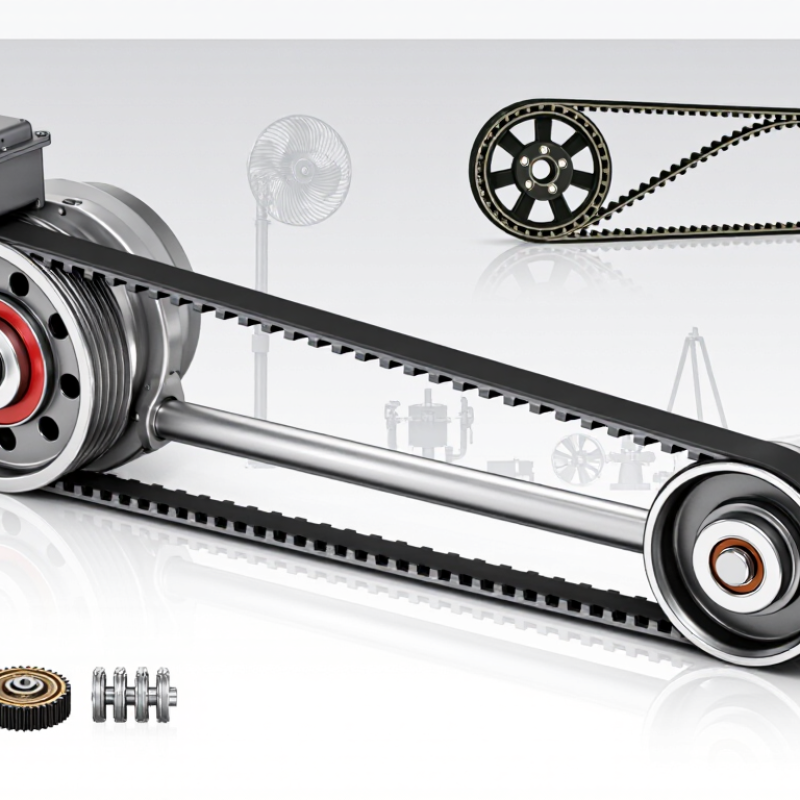
What Is a Belt Drive System and How Does It Work?

What Is a Belt Drive System?

A belt drive system transfers rotary motion between shafts through a flexible belt and pulleys. One pulley receives power from a motor or engine. The belt then carries that motion to another pulley. This arrangement can change speed, direction, and available torque without direct metal-to-metal contact.

A typical system includes a driving pulley, a driven pulley, and a belt made from rubber, reinforced fabric, or similar materials. When the driving pulley turns, friction or specially shaped teeth grip the belt. The belt moves continuously around both pulleys, causing the second shaft to rotate. A tight, correctly aligned belt usually runs smoothly and quietly.

It looks simple. Alignment matters.

In practical maintenance, I check belt tension, pulley wear, and signs of cracking. A loose belt may slip during startup, leaving a faint squeal and reducing power transfer. An over-tightened belt can load bearings unnecessarily. Dust, heat, moisture, and repeated vibration also shorten service life. Engineers select belt size and pulley diameter according to speed, torque, center distance, and operating conditions. Timing belts use teeth for precise synchronization, while smooth belts suit many general-purpose drives. The distinction is important. Belt systems are efficient and easy to service, but they are not maintenance-free. Even a carefully designed drive can perform poorly when installation measurements are rushed or inspection intervals are ignored.

What Are the Main Components of a Belt Drive?

What Are the Main Components of a Belt Drive?

A belt drive system transfers rotary motion between shafts through a flexible belt and pulleys. The driving pulley connects to the power source, while the driven pulley turns the machine’s working part. Their diameters influence speed and torque. A smaller driving pulley paired with a larger driven pulley usually reduces speed but increases turning force.

The belt is the working link. It may have a smooth surface, teeth, or a V-shaped profile, depending on the required grip and load. Pulleys must match the belt profile precisely. Shafts support the pulleys, while bearings help them rotate with less friction. An idler or tensioner can maintain proper belt tension and guide the belt along its path. Too little tension causes slipping. Too much tension can overload bearings.

Protective guards cover moving parts and reduce contact risks during operation. In practical maintenance, alignment deserves close attention. A pulley can appear centered while still sitting at a slight angle. That small error may create edge wear, vibration, or belt noise within hours. Checking tension, pulley alignment, cracks, and abnormal dust gives useful evidence about system condition. The explanation is not always perfect, though. Temperature, moisture, and sudden loads can change belt behavior, so one inspection should not define the entire system.

How Does Power Transfer Through a Belt Drive?

Power transfer begins when the driver pulley turns with the motor shaft. Friction grips the belt, creating a moving loop. That loop carries torque to the driven pulley. In a toothed system, matching teeth transfer force with minimal slip. In a friction system, belt tension and surface contact matter more.

Pulley diameter controls speed and torque. A smaller driver pulley usually makes the driven pulley rotate more slowly, but with greater torque. The basic ratio is simple: driven speed equals driver speed multiplied by driver diameter, then divided by driven diameter. Real systems are less tidy. Stretch, heat, dust, and poor alignment reduce useful output. A belt can look tight and still transfer power poorly.

The International Energy Agency’s Energy Efficiency 2023 report estimates that electric motor systems consume about 53% of global electricity. That figure shows why small transmission losses deserve attention. The U.S. Department of Energy’s Motor Systems Market Assessment also identifies motor-driven equipment as using roughly 68% of industrial electricity in the United States. Correct tension, clean pulleys, and accurate alignment protect that consumed energy. Maintenance guidance often favors checking tension under operating conditions, not only by sight. This is where my earlier assumption was incomplete: a calculated ratio describes motion, not total efficiency. Measuring temperature, vibration, and speed gives a more reliable picture.

What Are the Different Types of Belt Drive Systems?

A belt drive system transfers rotary motion between shafts through a flexible belt and pulleys. The driving pulley receives power from a motor, while the belt moves the driven pulley. Speed changes depend on pulley diameter. A smaller driving pulley usually makes the driven shaft rotate faster. In a workshop, I have found that alignment matters as much as belt strength. Even a small offset can create noise, heat, and uneven wear.

Flat belt drives use wide, thin belts for relatively long distances between shafts. They run quietly but may slip under sudden loads. V-belt drives have a trapezoidal cross-section that fits into matching pulley grooves. This shape improves grip and handles moderate power effectively. Multiple V-belts can share a heavy load, although uneven tension may reduce their service life.

Timing belt drives use teeth on both the belt and pulleys. They maintain accurate shaft synchronization and resist slipping. This makes them useful where timing matters. Round belt drives are flexible and suit light-duty equipment, conveyors, and compact mechanisms. Variable-speed belt drives use adjustable pulley widths to change speed during operation. The categories are not perfectly clean. Some systems combine features, and real performance depends on load, temperature, tension, and maintenance. A belt that appears acceptable may still have internal damage. That is easy to overlook.

What Is a Belt Drive System and How Does It Work? - What Are the Different Types of Belt Drive Systems?
Data Dimension Flat Belt Drive V-Belt Drive Synchronous Belt Drive Round Belt Drive Variable-Speed Belt Drive
Basic operating principle A continuous flat belt transmits motion between pulleys mainly through friction and belt tension. A wedge-shaped belt fits into matching pulley grooves. Friction between the belt sides and groove faces transfers torque. Toothed engagement between the belt and pulley prevents relative slipping and maintains a fixed timing relationship. A circular-section belt runs in rounded pulley grooves and transfers motion through friction. A movable pulley or sheave changes the effective pitch diameter while the drive is running, altering the speed ratio.
Typical belt construction Rubber, polyurethane, leather, or polymer body with textile or high-strength reinforcement. Elastomer body with embedded tensile cords and a trapezoidal cross-section. Rubber or polyurethane body with molded teeth and reinforcing cords, commonly made from fiberglass, aramid, or similar fibers. Elastomer or polyurethane with a round cross-section; some designs use internal reinforcement. Usually a V-belt or specially designed variable-speed belt with flexible reinforcement and a durable wear layer.
Power-transfer method Frictional traction across the belt and pulley surfaces. Frictional wedging in the pulley grooves, which increases the effective contact force. Positive tooth engagement rather than friction alone. Frictional contact between the round belt and pulley groove. Frictional traction combined with a continuously adjustable pulley ratio.
Slip and speed accuracy Some slip and creep can occur, especially under changing loads or inadequate tension. Some slip is possible during overload, startup, or insufficient tension. Very low slip under correct installation; the synchronized relationship is suitable for timing applications. Some slip is normal because torque is transmitted by friction. Speed changes are possible during operation, but belt slip may occur if the belt is overloaded or the sheaves are incorrectly adjusted.
Common speed relationship Approximate driven speed is determined by the ratio of driver and driven pulley pitch diameters, with allowance for slip. Approximate speed ratio follows the effective pitch diameters of the two pulleys. Driven speed is determined by the ratio of the number of teeth on the pulleys. Speed ratio depends on the effective diameters of the round-belt pulleys. Driven speed varies as the effective diameters of the adjustable sheaves change.
Typical efficiency range Approximately 90%–98% when correctly aligned, tensioned, and operated within the design load. Approximately 90%–97%, depending on belt profile, tension, speed, alignment, and load. Approximately 95%–99% in a properly installed and lubricated-free drive, depending on design and operating conditions. Approximately 85%–95% in light- to medium-duty applications. Approximately 85%–95%, with efficiency affected by speed ratio, sheave position, belt pressure, and load.
Advantages Quiet operation, long center-distance capability, simple construction, and good suitability for high-speed drives. Compact design, good shock-load absorption, broad availability, and strong performance for general power transmission. Accurate synchronization, no routine lubrication, compact installation, and reliable timing under changing loads. Simple installation, low cost, quiet operation, and the ability to work with small pulleys and curved routing. Adjustable output speed, smooth acceleration, and the ability to match machine speed to changing process requirements.
Limitations Requires accurate alignment and tension control; may need large pulleys and can experience slip. Not suitable for applications requiring exact synchronization; heat, oil, misalignment, and incorrect tension can shorten belt life. Requires precise tooth matching, correct tension, and accurate alignment; tooth damage can occur under shock overload. Usually limited to lower power levels; stretching, wear, and slipping can become significant under heavy loads. More complex pulley adjustment, potential belt wear from high clamping forces, and reduced efficiency at extreme ratios.
Typical applications Conveyors, fans, textile machinery, line-shaft systems, and equipment requiring long shaft-center distances. Industrial machinery, pumps, compressors, agricultural equipment, ventilation systems, and general mechanical drives. Camshaft timing, indexing equipment, precision conveyors, packaging machinery, robotics, and positioning systems. Light-duty conveyors, small appliances, office equipment, roller systems, and compact material-handling mechanisms. Machine tools, variable-speed conveyors, processing equipment, mixers, and drives requiring adjustable output speed.
Maintenance priorities Check tension, pulley alignment, belt surface condition, splice condition, and signs of edge wear. Inspect for cracking, glazing, fraying, oil contamination, uneven wear, and incorrect tension. Replace matched sets when required. Inspect tooth wear, tooth shear, cord damage, pulley condition, alignment, and tension. Avoid bending the belt sharply. Check for stretching, cuts, flattening, contamination, and loss of grip. Confirm that the belt remains seated in the grooves. Inspect belt wear, sheave alignment, clamping force, adjustment mechanism, and operating temperature at different speed settings.
Effect of center distance Well suited to relatively long center distances when adequate tension and support are provided. Works across short to moderate center distances; excessive distance may require an idler or additional support. Can operate across a range of center distances, but the span must be designed to control vibration and tooth engagement. Generally used over short to moderate center distances in light-duty mechanisms. Usually designed for compact or moderate center distances because the sheave mechanism must maintain controlled belt engagement.
Noise and vibration characteristics Generally quiet, although vibration can increase with belt flutter, poor tension, or pulley imbalance. Usually quiet and smooth, with vibration increasing when the belt is worn, misaligned, or incorrectly tensioned. Can produce tooth-meshing noise, especially at high speed, but provides precise motion with limited slip-related vibration. Typically quiet at low and moderate speeds; noise may increase if the belt is stretched or poorly seated. Usually smooth at stable speed settings; vibration can increase if the belt slips or the sheaves are unevenly adjusted.
Best selection criteria Choose when long center distance, quiet operation, and moderate power transmission are important. Choose for general-purpose power transmission where compactness, shock absorption, and cost effectiveness are priorities. Choose when precise timing, repeatable positioning, or synchronization between shafts is essential. Choose for light-duty, compact, quiet mechanisms where simple routing and low cost are more important than high power capacity. Choose when the machine needs continuous speed adjustment without changing motors or using separate gear stages.
General safety considerations Install suitable guards around belts, pulleys, and rotating shafts. Stop and isolate the equipment before inspection, adjustment, cleaning, or belt replacement. Do not operate a belt drive with damaged guards, exposed reinforcement, severe cracking, or abnormal vibration.
Note: Efficiency ranges are approximate engineering values. Actual performance depends on belt material, pulley diameter, speed, transmitted torque, temperature, alignment, tension, contamination, and maintenance conditions.

What Are the Benefits and Limitations of Belt Drives?

A belt drive system transfers rotary motion between shafts through a flexible belt and pulleys. The driving pulley receives power from a motor. Friction or tooth engagement then moves the belt and turns the driven pulley. Changing pulley diameters adjusts speed and torque. A larger driven pulley usually produces slower rotation and higher torque.

Belt drives are popular because they run quietly and absorb vibration. They also tolerate small alignment errors better than many rigid drive systems. Installation is relatively simple, and replacement usually requires fewer specialized tools. A belt can connect shafts placed several feet apart. That flexibility helps in conveyors, fans, pumps, and workshop machinery. Maintenance is manageable. Operators should inspect tension, cracks, glazing, and unusual dust around the pulleys.

However, belt drives have limits. Friction belts may slip under sudden loads, reducing speed accuracy. Excessive tension can overload bearings, while low tension causes poor power transfer. Heat, oil, moisture, and abrasive dust can shorten belt life. Toothed belts reduce slip, but they still need accurate alignment and correct tension. In my experience, noise is not always a belt problem; worn bearings or uneven pulleys may be responsible. It is easy to blame the visible part. Engineers should also check operating temperature, startup loads, guard clearance, and the manufacturer’s service limits before selecting a belt drive.

What Is a Belt Drive System and How Does It Work?

A belt drive transfers rotary power between shafts through a flexible belt running over pulleys. The belt can provide quiet operation, absorb vibration, and accommodate relatively long center distances.

Typical efficiency by belt type: Flat and synchronous belts generally provide higher power-transfer efficiency, while V-belts offer strong grip and reliable performance under many industrial conditions. Actual efficiency depends on tension, alignment, load, speed, pulley size, belt condition, and maintenance.

Benefits: low noise, vibration isolation, simple maintenance, overload protection through slip, and flexible shaft spacing. Limitations: conventional belts may slip, require correct tensioning, wear over time, and typically need more space than compact gear drives.

FAQS

What is a belt drive system?

It transfers rotary motion between shafts using a flexible belt and pulleys. One pulley receives motor power. The belt carries motion to another pulley. Simple appearance can mislead.

How does a belt drive transfer power?

A driving pulley turns with the motor shaft. Friction or matching teeth move the belt. The moving belt rotates the driven pulley. Tension and surface contact affect performance.

How do pulley sizes affect speed and torque?

A smaller driving pulley usually makes the driven pulley rotate more slowly. It can also provide greater torque. A larger driven pulley usually reduces speed. The speed ratio depends on both pulley diameters.

What are the main benefits of belt drives?

They operate quietly and absorb vibration. They can connect shafts several feet apart. Installation is usually straightforward. Replacement often needs only basic tools.

What are the limitations of belt drive systems?

Friction belts may slip during sudden loads. Low tension reduces power transfer. Excessive tension can overload bearings. Heat, oil, moisture, and dust shorten belt life.

How should a belt drive be inspected?

Check tension, alignment, pulley wear, cracks, and glazing. Look for unusual dust near the pulleys. Listen for faint squealing during startup. Inspect temperature and vibration when possible.

What is the difference between smooth and toothed belts?

Smooth belts transfer force through friction and surface contact. They suit many general-purpose applications. Toothed belts use matching teeth for precise synchronization. They still require accurate alignment and correct tension.

Why can a belt drive become noisy?

A loose belt may squeal during startup. Misaligned pulleys can create uneven movement. Worn bearings may also produce noise. I once blamed the belt too quickly. That assumption needed checking.

Conclusion

A Belt Drive System is a mechanical power transmission arrangement that uses a flexible belt to transfer rotation and motion between two or more pulleys. Its main components include the driving pulley, driven pulley, belt, shafts, and supporting tensioning or adjustment parts. When the driving pulley rotates, friction or positive engagement causes the belt to move, which then turns the driven pulley. This process allows power and speed to be transferred over a distance while also making it possible to change rotational speed and direction.

Common types include flat belt, V-belt, timing belt, and round belt systems, each suited to different operating conditions. Belt drives are valued for their quiet operation, relatively low cost, simple maintenance, shock absorption, and ability to accommodate some distance between shafts. However, they may experience stretching, slipping, wear, and reduced performance in extreme temperatures or contaminated environments. Proper belt selection, alignment, tension, and regular inspection are essential for reliable operation.

Liam

Liam

Liam is a dedicated marketing professional with a profound expertise in the industry, where he excels at highlighting the unique advantages of our core products. With a keen understanding of market trends and consumer needs, Liam frequently updates our company’s professional blog, providing......